
Our muscles determine how we move, how we communicate with each other and the silhouette of our bodies. They are the engines of our movement; however, we are often not sure exactly how to look after them. In order to properly care for our muscles, we need to understand how they work.
Firstly, there are three types of muscle tissue: cardiac, smooth or visceral, and skeletal.
- Cardiac muscle is the muscle tissue that powers the heart and large blood vessels such as the aorta.
- Smooth or visceral muscle tissue powers our hollow organs, such as our gut, and small blood vessels.
- Skeletal muscle is the muscle tissue that powers our musculoskeletal system; this system will be the focus of this article.
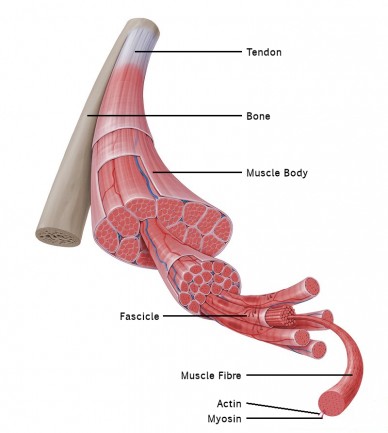
Muscle fibres are mostly made up of two proteins named actin and myosin. These two fibres slide alongside each other in both directions to perform contractions. They are bundled together by connective tissue that connects both blood vessels and nerve endings into the muscle tissue. These bundles, called fascicles, are then continuously layered to form the larger body of a muscle. The muscles are attached to the bones via tendons.
Skeletal Muscles Have Four Main Properties
- Excitable – the tissue can respond to stimuli/input
- Contractile – the tissues can lengthen and shorten to produce power and control to produce movement
- Extensible – the muscle can stretch without tearing
- Elastic – the tissues can return to their original shape after being stretched/moved
The main functions of the skeletal muscles are to produce force and movement to support the body, change posture, stabilise joints and produce body heat.
Muscle Injuries
Muscle injuries such as strains or tears occur when the muscle fibres are overstretched or are forced to contract too strongly to perform an action.
Muscle strains are divided into 3 categories:
Grade I
- Mild strain
- Only a few muscle fibres are over-stretched or torn
- Can be painful and tender
- The muscle retains normal strength and function
Grade II
- Moderate strain
- More fibres are overstretched or torn
- Severe pain
- Mild swelling and occasionally bruising
- There is a noticeable loss of strength
Grade III
- Severe strain or full tear
- All muscle fibres are torn right through
- A ‘pop’ is sometimes heard
- Severe pain
- Swelling, bruising and a gap in the muscle may be felt
- There is a complete loss of muscle function
Muscle strains and tears can be diagnosed by your physiotherapist in the rooms and may not always require imaging studies. However, if an imaging study is needed to confirm a diagnosis or pinpoint which specific muscle and where the tear is, your physiotherapist will refer you for an ultrasound.
If you suspect you have a muscle strain of any kind, apply the PEACE and LOVE principles. This will ensure that you do the correct things to prevent further injury.
First, Apply PEACE
- PProtect the Muscle: Prevent movement as much as possible for at least 72 hours. This can be done by using crutches and a sling or brace.
- EElevate the Muscle: Lie down or sit in a way that keeps the muscle above your heart.
- AAvoid Anti-inflammatory Medication: In the first 48–72 hours, it will delay healing and you will not feel better. The inflammatory process is actually important for healing in the body.
- CCompress the Muscle: Apply pressure to the muscles either with taping or a crepe bandage. Be careful not to cut off blood supply by applying it too tightly.
- EEducate: Your physiotherapist will educate you on the benefits of, and how to perform, active recovery for your specific injury; therefore, it is necessary to seek help as soon as you suspect an injury.
Then Apply LOVE
This will be done with the help of your physio.
- LLoad: In order for the muscle to heal sufficiently, the right amount of load needs to be applied at the right time. This promotes optimal repair, remodelling and tolerance to load in the fully healed muscle.
- OOptimism: Our brains play a key role in our healing from an experience of injury. A negative outlook on the injury and healing has been shown to produce longer healing times and worse outcomes. The converse is true for a positive outlook. Therefore, it is important to trust your healthcare practitioner during the treatment process. They will educate you on where you are in the healing process, and which measures to take when, in order for you to heal optimally.
- VVascularisation: (or development of blood vessels) A good blood supply is important for both healing and function. Pain-free cardiovascular exercise tailored to your needs by your physiotherapist is an important part of developing a good vascular system to the injured tissue.
- EExercise: Beginning exercise at the correct time is important to restore mobility, strength and proprioception to the injured site. Pain should be avoided, and your physiotherapist will guide you and provide an exercise program designed to optimise healing and return to function.
Muscle Spasms or Cramps
Muscle spasms or cramps are different to a muscle strain.
A muscle spasm is an involuntary painful contraction and is caused by overuse or overstimulation of the muscles.
A muscle cramp can last from a few seconds to a few hours and is also involuntary. It is caused by a lack of nutrients and a chemical imbalance in the muscle.
Muscle spasms and muscle cramps can lead to muscle strains and tears if not treated correctly.
Common Causes of Muscle Spasms
- Overuse: sudden changes in high repetition of muscle contractions, like increasing the frequency, duration or intensity of your training without allowing your muscles to adjust to the increase.
- Overload: sudden forceful contraction, such as a steep increase in weights.
- Overstretch: when a muscle is forcibly stretched beyond its normal limit or stretched excessively.
- Weakness: when a muscle is fatigued due to insufficient strength.
- Poor technique: poor form in the gym, during sport or an incorrect running gait (pattern) will load the muscle incorrectly and place more stress on the fibres.
- Poor management: neglecting an injury that has not healed correctly or completely.
- Inadequate warm-up: your muscles need to be prepared for the action when you are taking on more strenuous activities.
- Incorrect shoes: poor support of your feet will cause abnormal motions and forces through your muscles and joints. This can lead to weakness in some muscles and overuse in others. This is something that has to be monitored carefully, especially in runners.
Muscle strains, spasms and cramps are often also a sign of another problem, such as a biomechanical imbalance or insufficient treatment of an old injury. Muscles are the easiest part of our bodies to take care of and treat when injured. It is therefore very important that we seek to understand them and how we need to train and perform daily activities correctly. Optimal function relies on proper treatment, so don’t avoid the problem – rather sort it out before it can lead to other pains and strains along the chain.