
The term ‘correct posture’ might be confusing – what is it really?
“The Correct Posture” – we hear the words thrown around from the media to the workplace and sport. However, despite its importance it is often a bone of contention in our minds and daily lives, especially when sitting at a desk, which often feels like 24/7 instead of the 8–9 hours a day that we as a society average. Most patients that visit our practice mention posture as a problem they are aware of, but don’t know how to fix.
In this article we will dive a bit deeper into this topic, focusing specifically on standing and sitting postures in detail. We will discuss other forms of posture, mainly used for leisure or rest, in a later article.
Posture can be described as how we carry ourselves. The position or attitude of our bodies when we move or remain still. Posture is related to the position of the body and the specific activity that is performed, such as sitting, running or lying down.
The language we use to describe posture is based on the alignment of specific body segments or joints. The spine and the pelvis are the most prominent body parts when describing posture. This is because our trunks and spine are the basis for the rest of our bodies to provide stability and to move from.
Spinal Curves in a Correct Posture
When we talk about posture we need to also keep in mind the influence and stress placed on the body by gravity. The spine, other weight-bearing joints and stabilising structures need to maintain the body against the stress applied by gravity and other external forces.
There are 4 curves in the spine: Cervical, Thoracic, Lumbar and Sacral
To assess posture, we will look at the cervical, thoracic and lumbar curves. These curves give the spine flexibility and help to resist gravitational forces, sharing forces throughout the spine instead of only one part taking strain during movement. However, the alignment of these curves is also very important for function in the rest of the body, from movement of the limbs to optimal organ and muscle function.
There are two types of spinal curves:
- Kyphosis (moving towards the back)
- Lordosis (moving towards the front)
A Neutral Posture
The curves are balanced. When either of these curves is increased or decreased, it may lead to misalignment of the body and pain.

Line of Gravity (LOG)
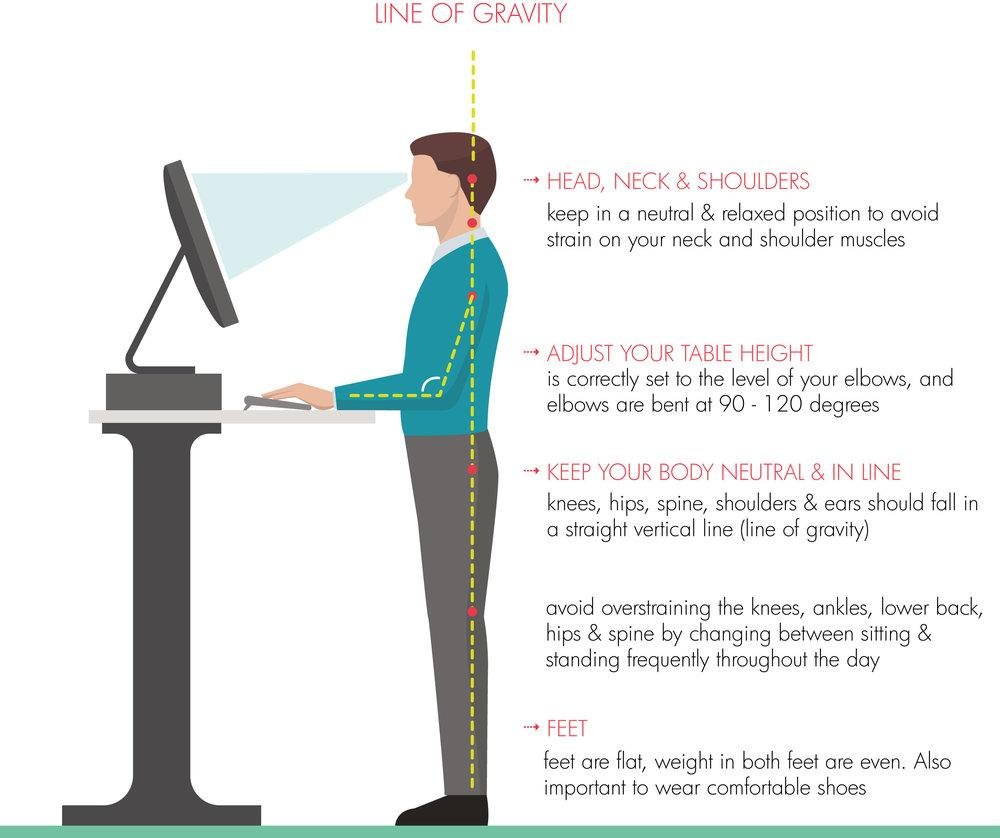
To assess posture, the easiest way is from the side, as this allows the view of body structures in relation to each other and to the line of gravity. The line of gravity is an imaginary line that is perpendicular to the ground and bisects the ear, shoulder and hip, and is in front of the knee and ankle in a neutral or ideal posture. Spinal curves are equally balanced on either side of this line and it travels through the body’s centre of gravity.
The centre of gravity in the neutral posture is just in front of the second sacral vertebra – this is also the centre of mass. However, while the centre of mass never shifts, your centre of gravity does shift as you move and your base of support changes.

Impaired Posture
An impaired posture puts mechanical stress and strain on joints, organs, ligaments and muscles. This stress arises due to stretching of joint capsules and ligaments, or compression of nerves, blood vessels or organs. Pain to these structures, even in the absence of specific injury or associated inflammation, is the result. When increased mechanical stress is prolonged, changes to the tissues and bones can occur, leading to long-term strain.
Only a small amount of muscle activation and endurance is needed to maintain the optimal or correct posture, because the alignment of muscles is optimal for their required actions. However, complete relaxation of the muscles, as seen in poor posture, exaggerates the spinal curves and puts joints in misalignment. This leads to excessive strain on joints, ligaments and overstretched muscles, causing strength and flexibility imbalances. Muscles become fatigued very quickly as they require more energy to counteract gravity. Muscles that are overstretched or lengthened become weak, as do muscles that are shortened, as they can only function in a shortened position. Read more on muscles and their function here.
Poor Posture
There are four main types of poor posture in the general population: lordotic, sway back, flat low back and military.
Each posture has different patterns of lengthened and shortened muscles which require correction. However, there are variations within these general types, so each person’s posture should be identified and corrected individually – no person is exactly the same. It is then necessary to visit your physio for a proper assessment.

| Posture Type | Head (Ear) | Neck | Thoracic Spine | Lumbar Spine | Pelvic Tilt | Shortened Muscles | Lengthened Muscles |
|---|---|---|---|---|---|---|---|
| Neutral | In line with the LOG | Gentle lordosis | Gentle kyphosis | Gentle lordosis | None | Balanced | Balanced |
| Lordotic | In front of the LOG (forward head posture) | Increased lordosis | Can have increased kyphosis (kyphotic/lordotic posture) | Increased lordosis | Anterior tilt | Hip flexors (iliopsoas), tensor fascia latae (ITB), rectus femoris (quads), erector spinae (back extensors) | Rectus abdominus, internal and external obliques, transverse abdominus – all part of the abdominal muscles |
| Sway Back (also called slouched or relaxed posture) | In front of the LOG (forward head posture) | Increased lordosis | Increased kyphosis | Increased lordosis | Anterior tilt – weight shifts forward causing hip extension | Upper abdominal muscles (rectus abdominus and obliques), hip and lumbar extensors | Lower abdominals, thoracic extensors, hip flexors |
| Flat Low Back | In front of the LOG (forward head posture) | Decreased lordosis | Decreased kyphosis | Decreased lordosis | Posterior tilt with hip extension | Rectus abdominus, intercostals, hip extensors | Lumbar extensors, hip flexors |
| Military | In front of the LOG (forward head posture) – can be associated with TMJ dysfunction as the jaw is forward | Increased lordosis | Decreased kyphosis | Decreased lordosis | Anterior tilt | Lumbar extensors, hip flexors | Abdominals, hamstrings |
Poor posture always causes pain, even if it’s only later on.
Symptoms of poor posture can include:
- Headaches
- Stiffness and decreased mobility
- Decreased cardiopulmonary endurance
- Muscle imbalance and fatigue
- Mental fatigue and general feelings of discomfort
Postural pain is usually relieved by movement and activity. Initially, there are no adaptive changes in the tissues of the body, but over time they will occur, making it harder or even impossible to gain an ideal posture. This means that good postural habits are extremely important sooner rather than later.
Sitting Posture and Workplace Postural Habits
Sitting is probably the most common position we find ourselves in, which has recently become exacerbated by lockdown and having to work at home. To sit in a chair is not a natural posture for the human body, as it allows all your muscles to relax and therefore decreases internal postural support. How your desk is set up and how you use your chair can help mitigate some of these problems, but it is still important to get up and move every 30 minutes to an hour.

The basis of a good sitting posture is, surprisingly, the position of your pelvis. The alignment of the pelvis determines how the rest of the spine is aligned. In the picture above, you can see how sitting with your pelvis tilted back decreases the curve of the lumbar spine, causing a slouched and rounded posture. It also causes undue strain on the coccyx, as it is not designed to bear the weight. To make finding the correct sitting posture easier, here are three steps.
The ABCs of Posture
These bring the body in line around the line of gravity, as in the neutral standing posture.
- Find a neutral pelvic tilt, where your weight is on your ischial tuberosities or sitting bones. Do this by finding a midpoint between a curved-under and an arched pelvis.
- Pull the tips at the bottom of your shoulder blades straight down, as if trying to get them into your back pockets. Do not pinch them together or stick out your chest.
- Gently lift the base of your skull off the top of your neck. This should feel like your whole spine is lengthening, and your chin automatically tucks in slightly.
The Correct Desk Set-Up
Below is a picture of a good set-up for your desk to help you maintain an optimal posture.
It is very important that your chair has a full backrest, and to lean into it while maintaining a neutral spine. You should not cross your legs, as that will shift the weight in your pelvis. You should also have armrests, or something to support your arms, otherwise you will lean forward or slouch to put your arms on the desk.

To stand and work has become a new craze, which is wonderful to take some strain off your spine – however, maintaining the correct standing posture is just as important as sitting correctly. Optimally you should switch between sitting and standing postures to avoid strain on your joints, as well as moving or stretching every 30 minutes to an hour.
Can I Sit on a Yoga Ball Instead?
A popular alternative is sitting on an exercise ball. This may be beneficial, if it is not too low for your desk. It should be switched out with a desk chair for back support, so both a yoga ball and a desk chair could be used – but your focus should be on your posture. For the correct posture your pelvis has to be tilted forward slightly when sitting, as if you are in a chair, and you should not slump. Never sit on the ball for too long (recommended 30–60 minutes at a time). If your ‘core strength’ is not optimal, you will not be able to maintain the correct posture and might put more strain on other joints.
In Conclusion
Poor posture can be caused by many things that form part of everyday life: repetitive or sustained positions, increased body weight or pregnancy, stress and lack of exercise, or incorrect shoes. It is important to identify and address the cause of poor posture, as well as the type of posture that is causing your pain and problems. Poor posture doesn’t have to be a burden, and the “office worker aches and pains” can be a thing of the past.
Pay your physiotherapist a visit to assess your posture, correct your posture and retrain your body before it’s too late.