
Indeed, for the general population and the fitness realm, the ‘core’ has inadequately been portrayed as just the abdominal muscles, specifically the Transversus Abdominis or ‘Corset Muscle’.
The human muscular system is essentially divided into two components: the intrinsic and extrinsic systems. Intrinsic muscles or muscle systems are the inner muscles and provide the stability and the centre or ‘core’ of movement and static positions; they may also be referred to as stabilisers. Extrinsic muscles are generally the larger outer muscles and are more directly responsible for our movement and strength; they may also be referred to as mobilisers. This being said, both the intrinsic and extrinsic muscle systems cannot function correctly, and therefore optimally, without each other. Often certain muscles can appear to cross systems. For the purpose of this article, we will focus on the Intrinsic System and explore the concept of the ‘core’ as defined by its scientific description, what this means for our daily lives and how we relate to our bodies both in and out of exercise spaces.
Strictly speaking, the ‘core’ of the human body can no longer be defined as a specific structure or group of structures. Rather, the ‘core’ is defined as a ‘System of Interdependent Mechanisms’ by which posture and movement control form the basis of our ability to perform all activities.
This means that the core is not one specific muscle or group of muscles. To avoid further confusion, the ‘core’ will be described by the term ‘core control’.
However, there are specific muscles that are always involved in ensuring that the ‘core control’ mechanism works correctly. The system is referred to as the ‘Abdominal Canister’. You may have heard your physiotherapist introduce you to this muscle group in exchange for the preconceptions of the ‘core muscles’. The ‘core’ is a system of mechanisms – and not just specific muscles. It might be confusing to think of it, but each house needs a foundation. The foundation is not just made up of one piece of cement, but rather concrete, stone, sand, water, mesh etc. This structure is similar to what is referred to as the Abdominal Canister: a combination of components that ensures the structure is stable and able to perform the task that it was designed to do.
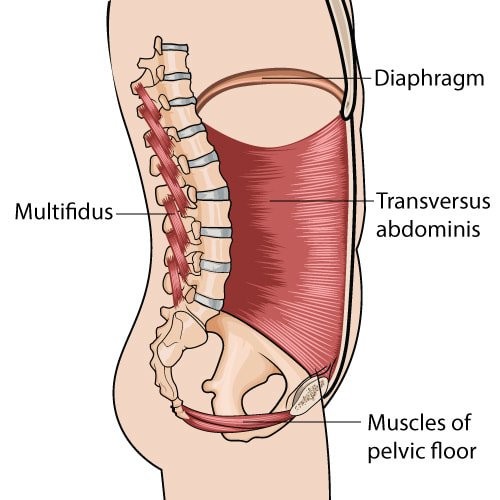
The muscles that comprise the Abdominal Canister are the Diaphragm, Transversus Abdominis, the Pelvic Floor Muscles and the Multifidus. These muscles, along with the spine, pelvis and lower rib cage, provide the walls, roof and base of the canister. In contrast to the previous conception that the ‘core’ is just the abdominal muscles, the different components each have a specific goal and purpose:
Diaphragm – Yes, It Is a Muscle
The diaphragm divides the abdominal cavity below from the thoracic cavity above. The diaphragm, from its position below the lungs, provides the main work of breathing. A negative pressure around the lungs is created, which encourages air to flow into the lungs as the diaphragm moves down towards the abdominal cavity. The diaphragm then moves back up towards the head and creates a positive pressure to expel air from the lungs. The pressure difference causes the diaphragm to move up and down; this can be seen through the rib movement when breathing. These same movements create the intra-abdominal pressure needed for core control. The diaphragm forms the roof of the Abdominal Canister.

The Pelvic Floor Muscles (PFM)
The PFM provides a hammock across the structure provided by the bones of the pelvis. It is made up of multiple muscles with attachments on the pubic bones, ischia and coccyx. They also support the bladder and reproductive organs, and control bowel and bladder continence. The pelvic floor is often referred to as the net or floor of the Abdominal Canister, as it forms the bottom of the canister.

Transversus Abdominis
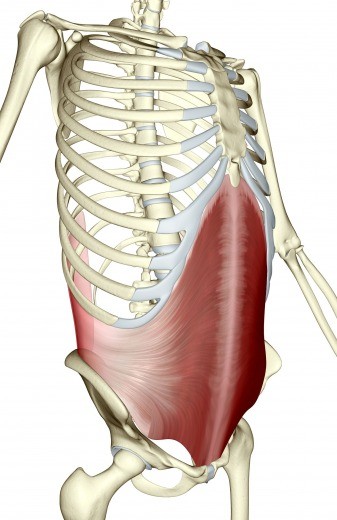
The Transversus Abdominis is the deepest of our abdominal muscles. It has sometimes been compared to a corset in its position and function. The Transversus Abdominis forms the front wall of the Abdominal Canister.
Multifidi
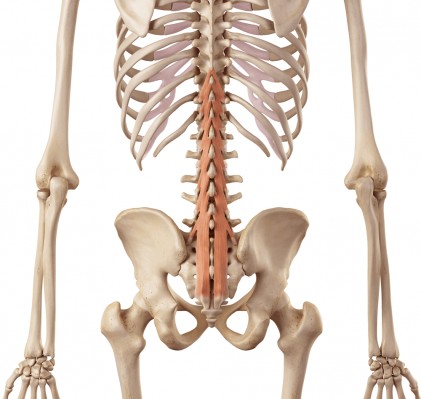
The Multifidi (a group of muscles that are called Multifidus) is a deep muscle group that sits close to the midline of the spinal column and connects to each vertebra via a complex network of fibres. This forms the back of the Abdominal Canister.
Teamwork
The PFM, Transversus Abdominis and Multifidi work together before movement of the body or limbs, or an increase of pressure such as heavy lifting, to support and prepare the ribcage, lumbar spine and pelvis.
The Function of the Abdominal Canister
An important function of the Abdominal Canister is to maintain Intra-Abdominal Pressure. Pressure and pressure changes are employed in many functions of the body, from the negative pressure that allows us to inhale air, to the positive pressure needed to empty your bladder. Intra-abdominal pressure provides stability to the spine and pelvis that is vital for postural control and movement against gravity, such as rising from a chair or lifting a heavy object. This is especially important in exercise and weight training.
If there is not sufficient core control, a pressure overload could be put on your joints and mobilising muscles. If there is too little pressure the same happens. This leads to failure in the structure, causing injury occurrence. For example, over-stiffening the Abdominal Canister or insufficient core control when doing a squat or deadlift will lead to a low back or hip injury, as there will be increased pressure through the spine and hips. If we over-train muscles and brace or stiffen up our Abdominal Canister, we can cause an excess of intra-abdominal pressure, and other injuries such as hernias, incontinence and organ prolapse can occur.
Breathing patterns play a foundational role in generating intra-abdominal pressure, which means that our breathing is directly linked to our postural control and is therefore an important mechanism of core control. The reverse is also true, meaning that your postural muscles support the ability of the diaphragm and ribcage to move correctly.
We Can Identify If We Have Poor Core Control by Looking at Our Posture
When our core is activated correctly, our head, shoulders and hips will be in line with each other and perpendicular to the floor when standing and looking from the side. A good way to find the correct alignment of the Abdominal Canister is to inhale deeply and exhale, bringing the bottom of your ribs together and activating your Transversus Abdominis to bring your ribs and pubic bone in line. This posture should be maintained with all normal activities of daily living and exercising. This pattern should also be maintained with the motion of diaphragmatic breathing. Below is a picture of correct and incorrect posture and how the Abdominal Canister appears in each of them.

Read more in Posture 101.
Diaphragmatic breathing refers to the correct breathing pattern of using your entire ribcage to breathe. Often, due to poor posture and stress, we breathe using the muscles in the shoulders and neck. This does not allow proper expansion of the lungs to take in a full volume of air. Our lungs are wider at the base, so sufficient air must reach there in order to get optimal oxygen into the bloodstream. By using the diaphragm at the base of the lungs to expand the chest, we allow the full amount of oxygen to enter the lungs and subsequently our bloodstream. Read more in Breathing: The Forgotten Art.
Try This: Diaphragmatic Breathing
A good exercise to practise diaphragmatic breathing is to lie flat on your back on the floor with your knees bent and body relaxed. Place a small pillow or towel on your stomach just below your ribcage. Take a deep breath in and imagine expanding your stomach and lower rib cage out. You should see the pillow or towel on your stomach rise gently. As you then exhale, imagine your stomach and rib cage sinking in as all the air leaves your lungs. You should see the pillow or towel gently lower towards the ground. This can be repeated in sitting once you feel it is easy lying down. You can use your hands instead of a pillow or towel to monitor your abdominal movements.
The Core Message
Core control is a complex system of bones, muscles and pressures. We must be careful not to oversimplify it or overtrain specific parts and ignore others. It is important to get a proper assessment of all the muscles and your breathing pattern in order to gain the right amount of intra-abdominal pressure to retrain optimal core control. This is because if one part of the system is restricted or not activated, it will cause an injury or ‘give’ in another part of the body. Due to this compensation, most joint and muscle injuries occur. Things like pregnancy, lying sedentary in bed, coughing due to illness, or spending hours at your desk in a sedentary posture can cause changes in the Abdominal Canister. They ‘deactivate’, overstretch or overwork certain parts of the Abdominal Canister, which creates an imbalance.
Unfortunately, there is not a one-size-fits-all exercise you can do to gain core control. For optimal movement, you need your core control. This will help you to stay strong and ultimately have fewer injuries, because your body will not compensate. In order to gain the correct advice and exercises for you and your lifestyle, it is advised that you seek a thorough assessment with your physiotherapist.